Abstract
Pretrained latent world models can support visual planning and control, but their predictions may fail when physical dynamics change at deployment. We study whether such models can adapt from only a few interactions without modifying their pretrained weights or identifying the changed physical parameters. We introduce a few-shot residual adaptation approach that learns self-supervised corrections from latent prediction errors. The corrections are applied both inside the latent predictor and directly to its predicted latent state, while the pretrained world model remains frozen. We evaluate the approach in simulation and on a real robot under center-of-mass and friction shifts. These changes reduce the success of the frozen model to near zero. Using three interaction episodes for adaptation, our dual-site approach recovers 90% success under the center-of-mass shift and 100% under the modified friction on the real robot. Ablations show that correcting both locations outperforms single-site adaptation. Our diagnostics further suggest that much of the learned correction reduces a general prediction mismatch, while successful control also depends on shift-specific information captured during adaptation.
Method
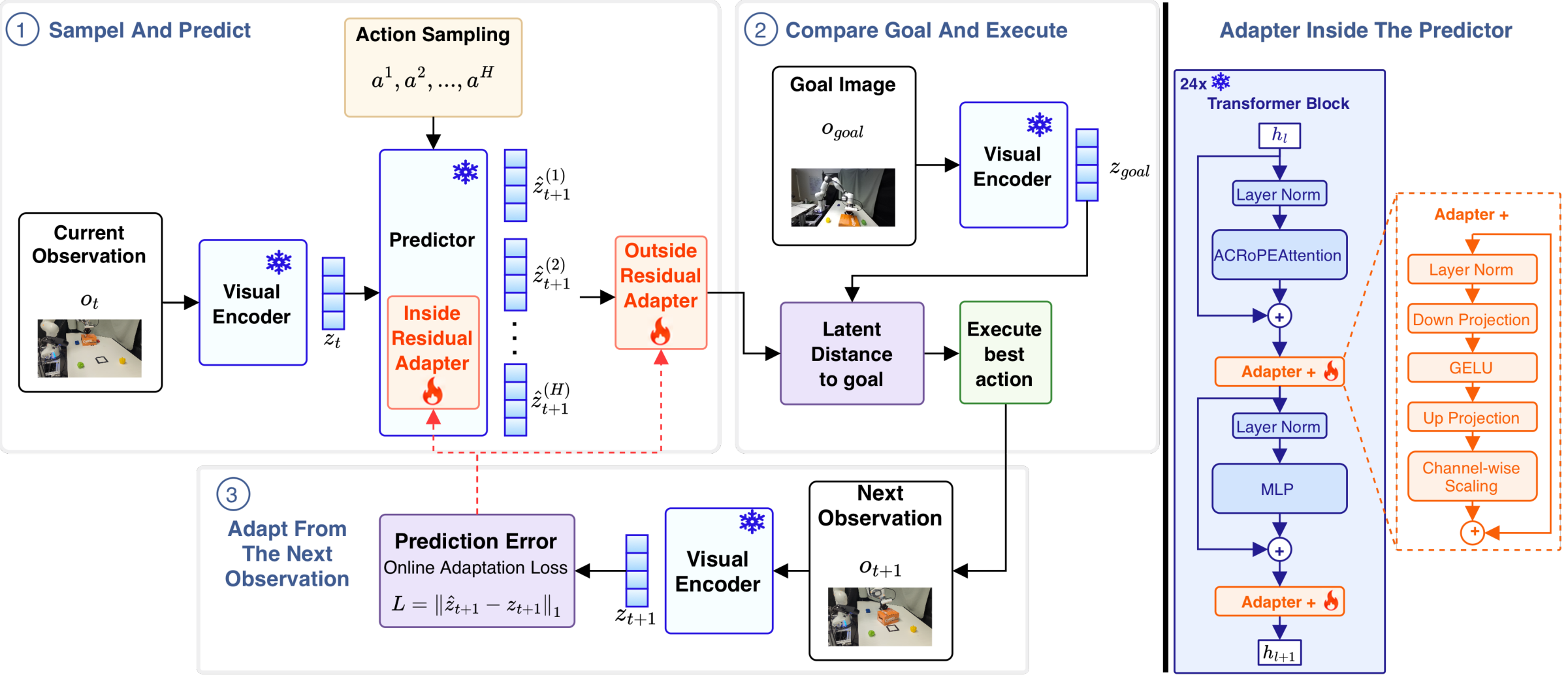
We adapt a pretrained latent world model to the dynamics of a deployment scene without changing any of its original parameters. The pipeline alternates model-predictive control with self-supervised adaptation over three interaction episodes.
Latent world model and planning
Our base model is DUET-DINO, a variant of V-JEPA 2-AC. It predicts action-conditioned latent transitions from a static side camera and a wrist camera. Planning uses a one-step cross-entropy method (CEM) controller. We keep this controller fixed and adapt only the latent predictions it consumes.
Dual-site latent correction
Inside the predictor
We insert Adapter+ modules at two points in every block of both predictor heads, after the attention residual and after the completed block. Two sites across 24 blocks and two heads give 96 modules in total. They can reshape the intermediate computation without touching the pretrained backbone.
Outside the predictor
A shared token-wise residual MLP then corrects whatever the adapted predictor produces. It is 1280 → 1024 → 1024 → 1280 with GELU activations and no input normalization, and sees only the predicted token, not the previous latent or the action.
Together the internal adapters (25.6M parameters) and the external MLP (3.7M) add 29.2M trainable parameters, 4.53% of the frozen predictor.
Self-supervised online adaptation
The adapters learn only from prediction errors between predicted and observed transitions.
After each of the first three episodes, we update the adapters sequentially in two phases. First, the internal Adapter+ modules are trained for 25 steps. We then freeze these adapters, recompute one-step predictions, and train the external MLP for 25 steps.
- Record 1 Episode
- Replay Buffer
- Phase 1Train Inside Adapter
- Phase 2Train Outside Adapter
- Update Model
Setup
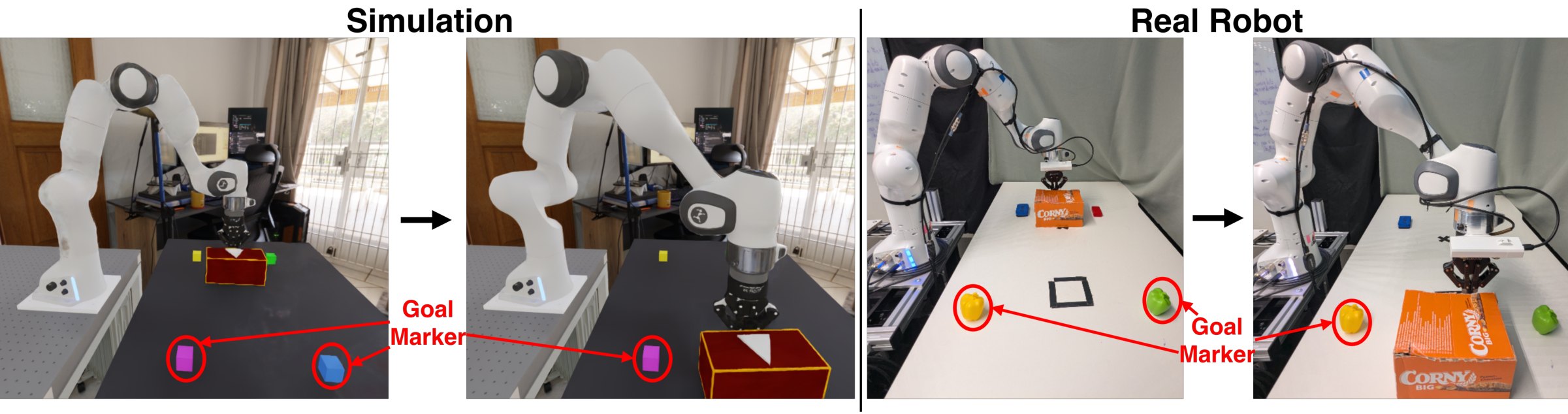
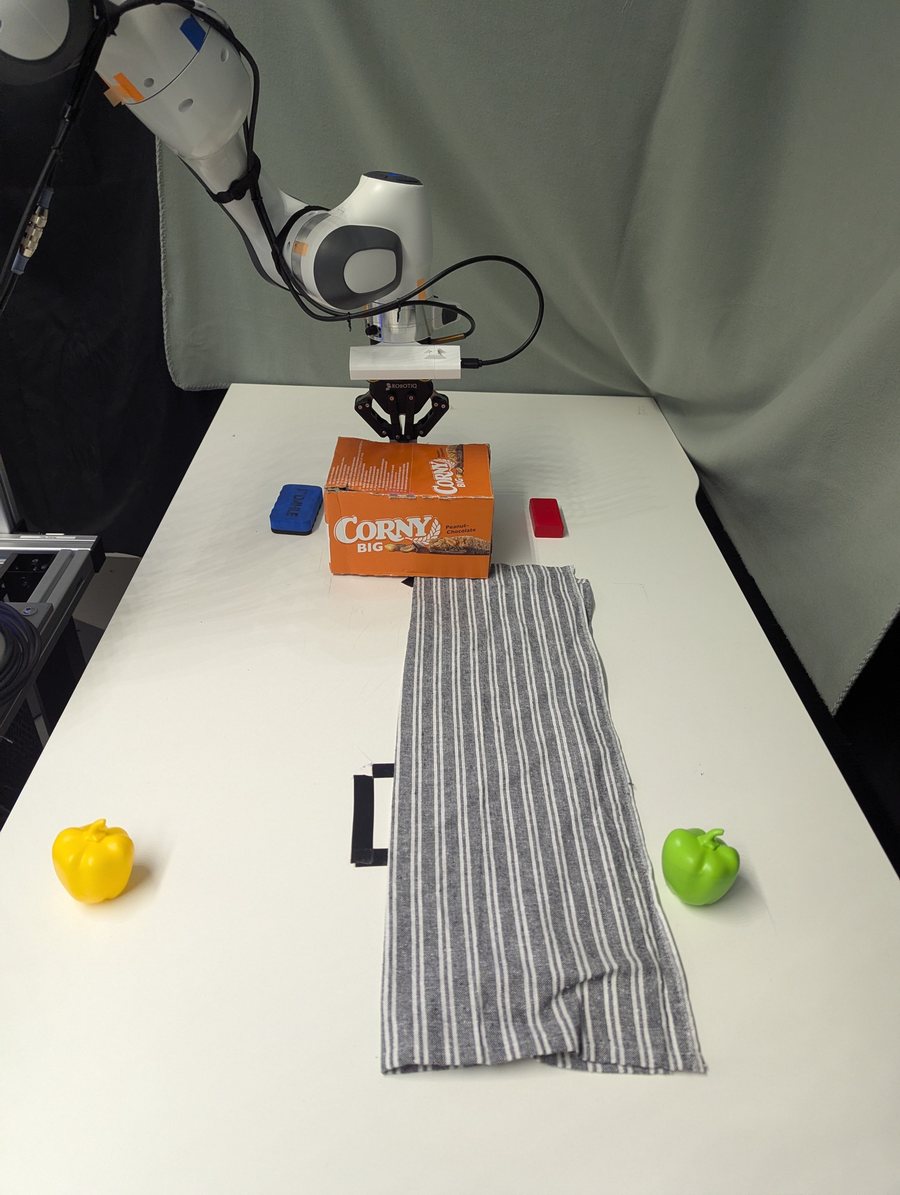
Task and dynamics shifts. We study goal-directed box pushing, where the robot uses its closed gripper to push a box to a target pose. In the center-of-mass (CoM) shift, a hidden weight moves the center of mass to the right. In the modified friction, a cloth under half of the track creates asymmetric friction across the box.
Platforms. Real robot: We use a Franka Panda in the DROID configuration with a static side camera and a wrist camera. The three adaptation episodes contain only 24 frames in total. Simulation: We reproduce the same two-view tabletop setup in the RoboLab simulator.
Protocol. In simulation, we additionally evaluate a Diffusion Policy as a non-world-model baseline. An episode is successful if at least half of the box crosses the goal marker, which corresponds to 8 cm on the real robot and 4.7 cm in simulation, while its orientation stays within about 25° of the starting orientation.
Results
RQ1
How do physical dynamics shifts affect planning with a pretrained latent world model?
Under general dynamics, Diffusion Policy achieves 96.0% success in simulation and the frozen DUET-DINO model reaches 85.3% in simulation and 86.7% on the real robot. After shifting the box's center of mass, success drops to 0% for all baselines. After changing friction, the frozen DUET-DINO model reaches only 3.3% on the real robot.
RQ2
How much of the planning can a few-shot adaptation recover?
Shift-specific full finetuning and LoRA recover some performance, but vary substantially across the two shifts. In contrast, our shift-specific dual-site adapter reaches 90.0% success under the center-of-mass shift and 100.0% under the modified friction.
Success rate (%) ↑ · Simulation · Shifted CoM
Simulation results are mean ± standard deviation over three seeds (50 runs each).
RQ3
How does correction placement affect adaptation?
No single-site method fully recovers planning: the best internal method, LoRA, reaches 32.7% success, while the best external correction reaches 24.0%. Our dual-site adapter performs substantially better at 56.7%, with sequential training also outperforming joint training (56.7% vs. 44.0%). The two sites also show complementary failure modes: internal adaptation often moves in the correct direction but can be unstable, while the external residual gives more consistent motion but may move in the wrong direction.
Success rate (%) ↑ · Real robot
The four best-performing adapters are evaluated on the real robot. Modified friction is evaluated only there as it was unreliable in RoboLab. Each real-robot experiment uses 30 runs.
Shifted CoM
Modified friction
Rollouts
More episodes
RQ4
What does the learned adaptation capture?
The general-dynamics adapter is trained on the general task with the same three-episode self-supervised procedure as our adapter, and it reduces prediction error almost as much as the CoM-shift adapter: it shares 95.3% of the side-view and 71.7% of the wrist-view error reduction. However, under the CoM shift it achieves only 6.0% success, compared with 72.0% for the CoM-shift adapter. Thus, reducing prediction error alone is not sufficient for successful control.
Lower prediction error does not mean better control
General adapter: trained without dynamics shift. CoM-shift adapter: trained on the shifted center of mass.
General adapter's error reduction, relative to the CoM-shift adapter (%)
Planning success under CoM shift, general vs. CoM-shift adapter (%)
Error reduction barely depends on the dynamics shift
Error drops most where little moves.
Side-view error reduction by task (%)
Side-view error reduction by patch motion (%)
Adaptation also comes at a cost: the CoM-shift adapter reaches only 54.0% on the general task, compared to 85.3% for the frozen model. The adapter remains effective under changes in object color, table, marker, and background, but transfers poorly between simulation and the real robot, suggesting that it learns a deployment-specific correction rather than a transferable physics model.
Planning success by adapted predictor head under shifted center of mass
Success rate (%) ↑ · Simulation · 50 runs from a single adaptation seed
The arrow separates the training condition from the test condition. The adapter is trained on the red box in the unchanged scene and never on these variations. All entries are success rates in percent over 50 runs from a single adaptation seed.
| Variant / protocol | Success rate (%) ↑ |
|---|---|
| Dynamics transfer (train → test) | |
| General dynamics → CoM shift | 6.0 |
| CoM shift → CoM shift | 72.0 |
| CoM shift → nominal task | 54.0 |
| Adapter location | |
| Wrist predictor only | 18.0 |
| Side-view predictor only | 14.0 |
| Domain transfer (train → test) | |
| Real robot → sim (50 steps) | 10.0 |
| Real robot → sim (25 steps) | 0.0 |
| Sim → real robot | 0.0 |
| Variation | Success rate (%) ↑ |
|---|---|
| Red box (seen) | |
| Original scene | 72.0 |
| New table | 84.0 |
| New marker | 54.0 |
| New background | 60.0 |
| Turquoise box (unseen) | |
| Original scene | 74.0 |
| New table | 62.0 |
| New marker | 74.0 |
| New background | 60.0 |
| New table + marker | 54.0 |
BibTeX
@article{suligafew,
  title={Few-Shot Residual Adaptation of Pretrained Latent World Models},
  author={Suliga, Jakub and Vanjani, Pankhuri and Nilavadi, Nisarga and Burgard, Wolfram and Lioutikov, Rudolf}
}