What Makes a VLA Reactive?

A Study of Execution Strategies for Dynamic Manipulation

Zhuoyue Li1, Zhendong Han1, Pankhuri Vanjani1, Wenting Li1, Rudolf Lioutikov1,2
1Intuitive Robots Lab (IRL), Karlsruhe Institute of Technology (KIT) 2Robotics Institute Germany (RIG)
CoRL 2026 Workshop  ·  Efficient Foundation Models for Real-Time Embodied AI  ·  ★ Spotlight

Moving-cup placement

Rolling-can grasping

Conveyor-belt picking

Abstract

Vision-language-action (VLA) models predict chunks of future actions, and when objects move, those chunks go stale before they are executed. We study what makes a pretrained VLA reactive, using π0.5 on two dynamic simulation benchmarks and three real-robot tasks. We vary the prediction and execution horizons, compare synchronous and asynchronous inference, test methods that deliver actions sooner or keep successive chunks continuous, and adapt the policy with motion cues and latent-space reinforcement learning. The best prediction horizon is about one second, and the best execution horizon depends on the checkpoint. Short horizons help more with asynchronous execution, and methods that keep the trajectory continuous outperform those that only reduce latency. Adapting the policy repairs targeted failures, but on the conveyor task changing the execution horizon gained as much. Reactivity depends on the execution pipeline as much as on the policy, so both should be evaluated together.

Study Design

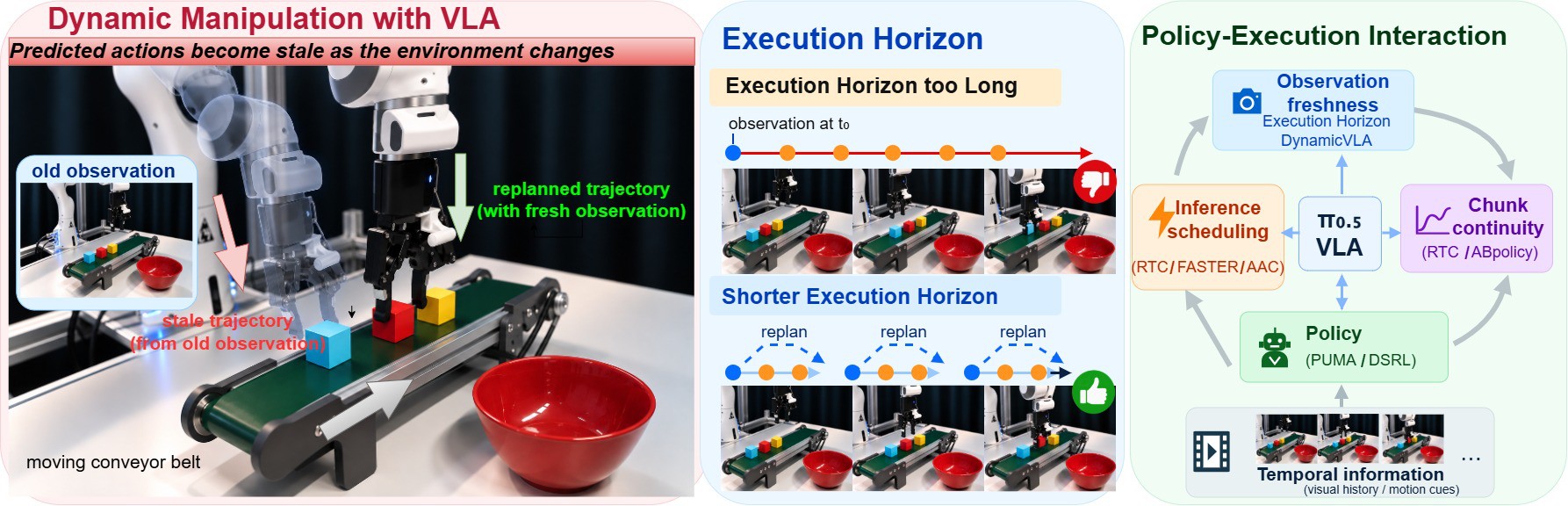
Overview: dynamic manipulation with a VLA, execution horizon, and policy-execution interaction

Dynamic VLA manipulation depends on the interaction between prediction and execution horizons, inference scheduling, chunk continuity, and policy behavior, which together determine whether frequent replanning improves task performance.

Given an observation ot, a language instruction, and the proprioceptive state, the policy predicts an action chunk of length H (the prediction horizon), of which only the first s ≤ H actions are executed (the execution horizon). In synchronous execution the robot waits while the next chunk is computed; asynchronous execution overlaps inference with motion, but must account for inference delay and can introduce discontinuities when switching between independently generated chunks.
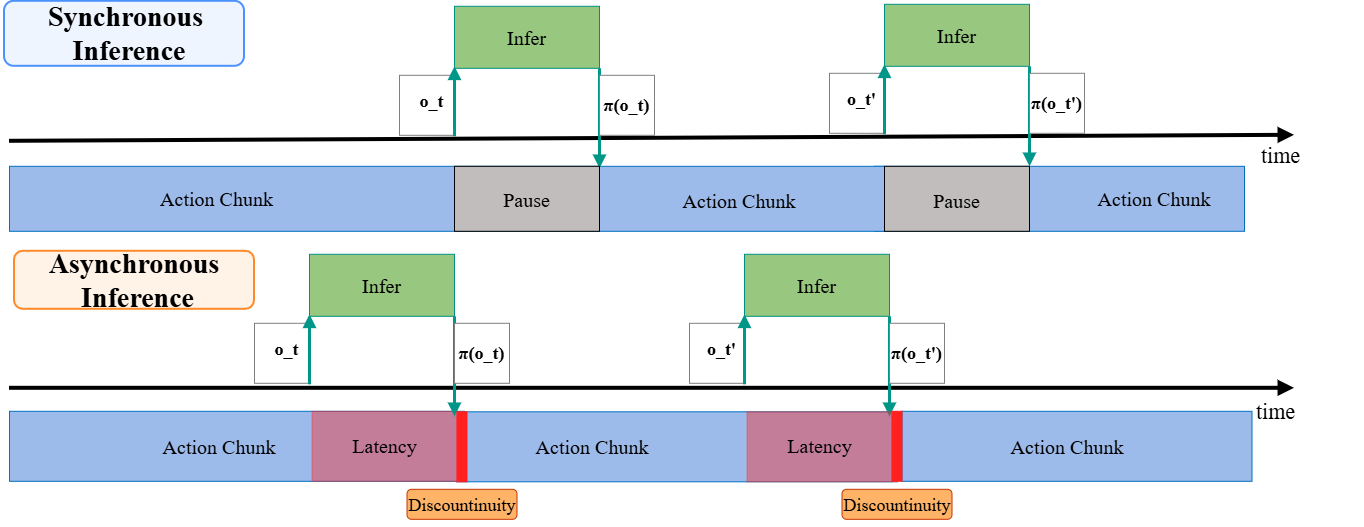
Synchronous vs. asynchronous execution timelines

Synchronous execution introduces waiting periods, while asynchronous execution overlaps inference with motion but may cause inter-chunk discontinuities.

All interventions are implemented within a common π0.5 framework and target complementary limitations of dynamic manipulation: temporal commitment, delayed or discontinuous execution, and insufficient motion information or behavioral adaptation.

MethodModelInferenceExecutionAction Rep.Target
RTC✓Chunk transition
FASTER✓✓Action generation
DynamicVLA✓✓Execution alignment
ABPolicy✓✓✓Chunk continuity
PUMA✓Motion information
AAC✓✓Execution horizon
DSRL✓Latent steering

Method Rollouts

Conveyor belt, 5k checkpoint · execution horizon s = 5 vs. s = 15

π0.5 (baseline)

Conveyor belt, s = 10

Rolling can (fast), s = 10

RTC · Chunk transition

Conveyor belt · execution horizon s = 5 vs. s = 40

FASTER · Action generation

DynamicVLA · Execution alignment

Conveyor belt · 20 Hz vs. 30 Hz control

ABPolicy · Chunk continuity

Conveyor belt · success

Moving cup, s = 35

PUMA · Motion information

Conveyor belt · high inference latency

AAC · Execution horizon

Conveyor belt (5k, s = 10) · before vs. after DSRL training

DSRL · Latent steering
Results

RQ1: How do prediction and execution horizons affect dynamic manipulation?

RQ1 results

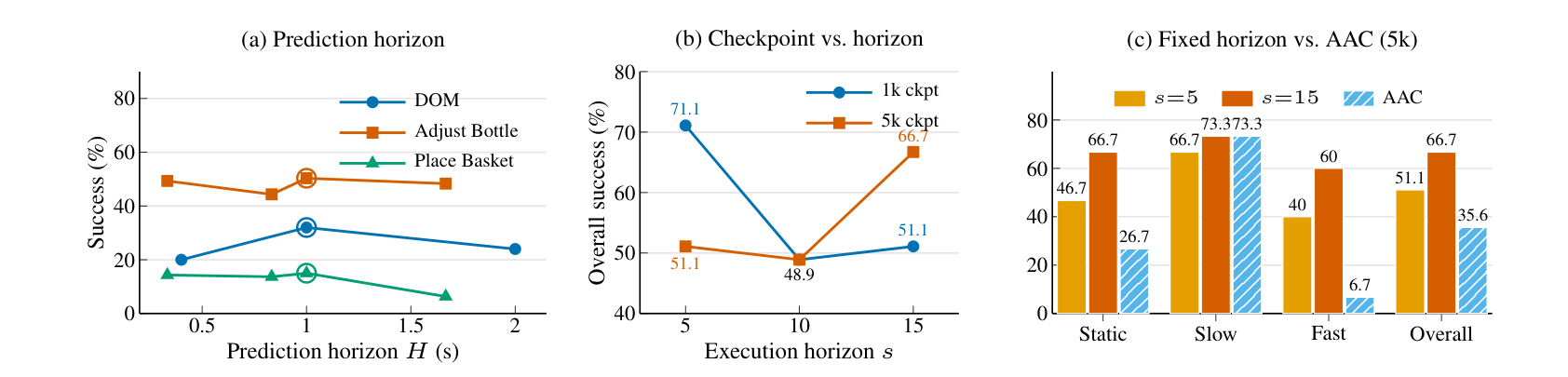
(a) Success vs. prediction horizon in seconds on DOM and DOMINO; rings mark the best horizon. (b) Conveyor-belt success of the 1k and 5k checkpoints across execution horizons. (c) The 5k checkpoint with fixed horizons and AAC per belt condition (H=20, asynchronous, 45 trials each).

  • A prediction horizon of about one second works best. With longer chunks, the robot keeps executing a plan made for an object that has since moved on.
  • The best execution horizon depends on the checkpoint. The 1k checkpoint works best at s=5 and the 5k checkpoint at s=15. The 5k policy barely moves during the first steps of each chunk, so replanning sooner just re-predicts the same slow start.
  • Adaptive horizons do not help. AAC never beats the best fixed horizon: its entropy trigger fires at the wrong moments, and sampling many candidate chunks delays the next one.

RQ2: When does more frequent replanning actually help?

RQ2 results

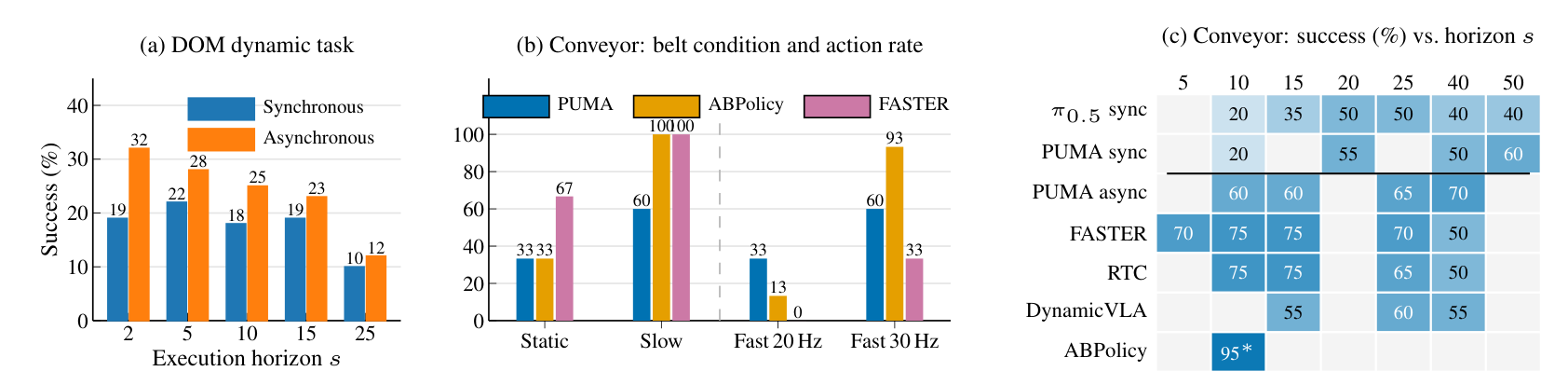
(a) DOM dynamic task with the same policy (H=25) under synchronous and asynchronous execution. (b) Conveyor-belt success of the best configuration of each method per belt condition and action rate (15 trials per bar). (c) Conveyor-belt success of every method across execution horizons; synchronous methods above the rule. ABPolicy (*) was evaluated only at s=9.

  • Short horizons help more with asynchronous execution. In synchronous execution, every extra chunk adds a wait during which the robot stands still and the object moves on.
  • Continuity matters more than latency. ABPolicy and RTC are the best methods on the conveyor although FASTER has the lowest latency: a fresh action is only useful if the robot can follow it without a jump.
  • Higher action rate helps on the fast belt. Going from 20 to 30 Hz lifts ABPolicy from 13% to 93% and FASTER from 0% to 33%.

RQ3: Can temporal information or reward-guided adaptation make the policy more reactive?

RQ3 results

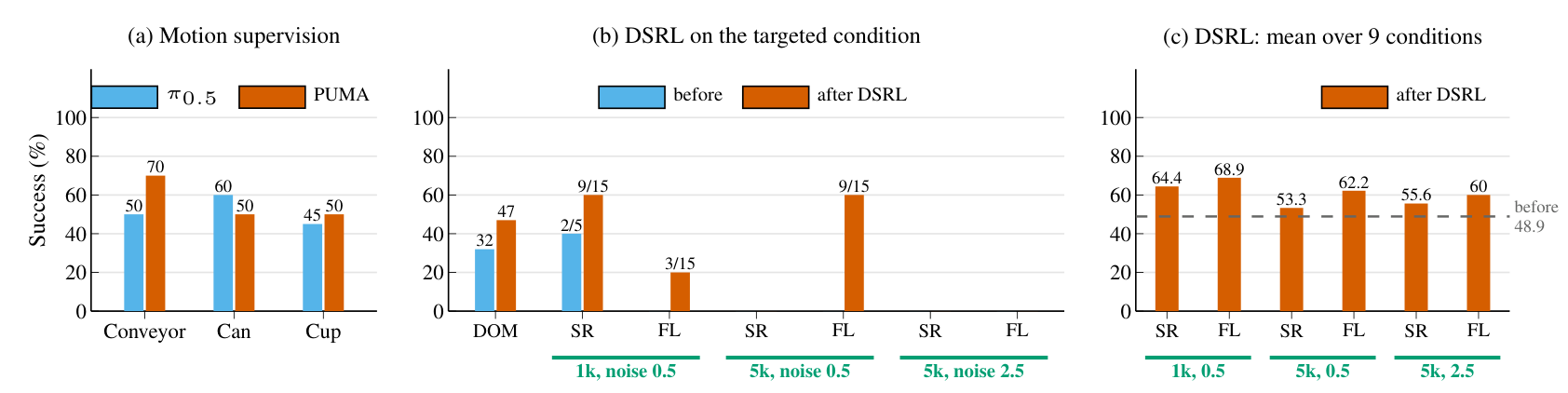
(a) Best success of π0.5 and PUMA on each real-robot task. (b) Success on the targeted condition before and after DSRL (DOM in percent; conveyor as success counts). (c) Mean success over all nine conveyor conditions after DSRL; the dashed line is the 48.9% of the original checkpoints.

  • Motion information gives mixed results. PUMA helps on the conveyor but not on the rolling can, and its motion cues only pay off with asynchronous execution.
  • Latent steering repairs targeted failures. DSRL raises the targeted condition from 32% to 47% on DOM and from 0% to 60% on the hardest conveyor case, without touching the VLA.
  • But the gains stay local. DSRL lifts the 1k checkpoint to 64–69%, while the same checkpoint reaches 71% at s=5 with no training at all.

BibTeX

@misc{li2026makesvlareactivestudy,
      title={What Makes a VLA Reactive? A Study of Execution Strategies for Dynamic Manipulation},
      author={Zhuoyue Li and Zhendong Han and Pankhuri Vanjani and Wenting Li and Rudolf Lioutikov},
      year={2026},
      eprint={2611.15491},
      archivePrefix={arXiv},
      primaryClass={cs.RO},
      url={https://arxiv.org/abs/2611.15491},
}